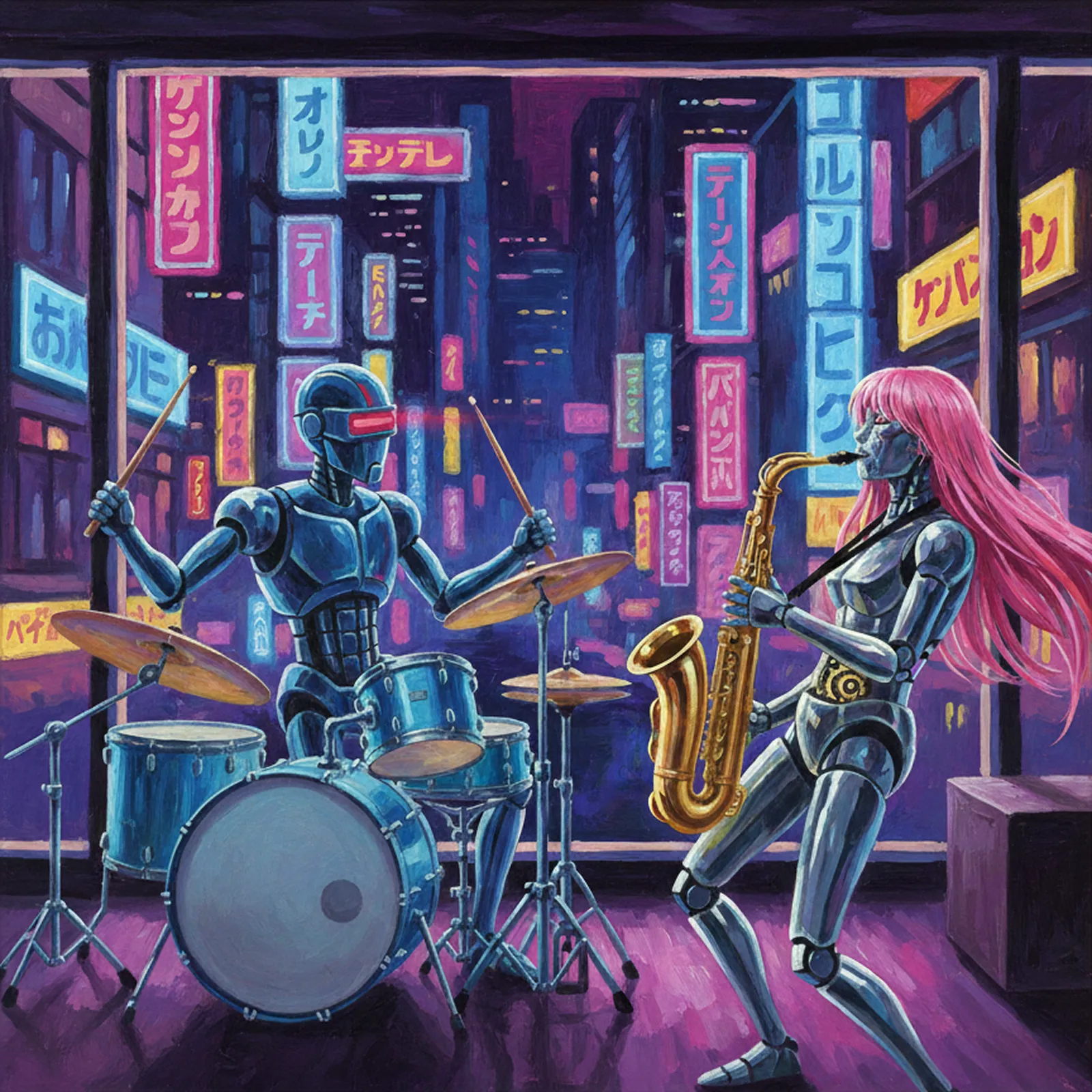
I made an album with AI. 12 tracks of lofi jazz blind box music. Saxophone-driven.
The songs were done. But then came a surprisingly interesting problem: what order should these 12 tracks go in?
Being a short-attention-span creator in the AI era is genuinely fun. Never thought I’d be arranging an album one day.
The Pokémon lineup theory
In Pokémon, your team of six each has different strengths. The order you send them out often decides whether you win or lose.
Albums work the same way. Each song is a Pokémon. You need to figure out the best order to send them into battle for the most exciting match. Except unlike Pokémon, you can’t swap mid-fight.
I thought about it for a while and came up with a few principles.
The first track is onboarding. Like an app’s first impression, or the first 45 seconds of a YouTube video. If this one’s bad, the album is dead. But don’t lead with your ace (the strongest Pokémon on your team). Putting your ace first might maximize that one track’s plays, but it hurts the album overall. Everything after the ace only gets weaker, and the listener’s experience declines. The first track should be your second or third strongest, with a moderate BPM. Not too fast, not too slow. It sets the stage.
The second track should complement the first. This is where the listener first hears your “other side.” Together, the first two tracks should give the album a complete first impression. So the second needs to feel different from the first, but equally good. Consider putting one of your top three here.
Put your ace at the 25%-60% mark. This is the album’s centerpiece. Too early and you hurt the experience. Too late and nobody hears it. The mega-hit “APT.” isn’t the first track on Rosé’s album either. Can you put it last? Unless you’re Jay Chou, who can close with an epic war ballad, the last track is almost always the least listened to. Wasting your ace there is a shame. If the earlier tracks hold up well enough, you can push the ace a bit further back.
Interludes are the pickled ginger of sushi. I never understood why albums included those one-minute-something short tracks. I’d never save them to a playlist. Now I get it. Just like palate-cleansing ginger between sushi pieces, or that little plum vinegar drink at a teppanyaki restaurant. An interlude resets your ears for the next chapter.
The last track is the curtain call. It should make the listener feel “ah, it’s over.” This can be the slowest, quietest track on the album.
Tempo should transition gradually, not jump. Don’t suddenly go from high energy to dead slow. Mood, on the other hand, should alternate constantly. Avoid long stretches of the same emotion.
My sequencing
With these principles in hand, I laid out all 12 tracks and tagged each one with BPM, mood, how much I liked it, and duration. Then I locked in four key positions: first track, second track, ace, and last track. The rest filled in by tempo and mood.
The final result:
- i will be here (2:53, 80 BPM) Third strongest. The drum pattern works as an opener. Has that “I wonder what’s coming next” anticipation.
- we together strong (2:46, 84 BPM) Second strongest. More relaxed than the first. Together they set the tone for the whole album.
- midnight shower thoughts (2:24, 78 BPM) The background music for my first YouTube video. More playful. Gives off Persona 5 idle screen vibes.
- minding my own business (2:46, 80 BPM) Contrasts the previous track. Very chill.
- surfing the unknown (2:38, 78 BPM) Love how the pad rises up and drops back down.
- tangled (3:02, 75 BPM) Fourth strongest. The image in my head is dancing while telling someone “I’ve got my eyes on you.”
- endless search for meaning (4:16, 75 BPM) The ace. No idea how this one came out. The only track over 4 minutes on the whole album. I generated 20 more with the same style and prompt. None came close. The one I’ve replayed the most.
- donbabadon (1:20, 75 BPM) Interlude. I was making instrumental tracks, and then the AI suddenly started singing nonsensical syllables that sounded like “dong-ba-ba-dong.” I couldn’t stop laughing. Decided to keep it.
- not stopping me (2:08, 100 BPM) After the intermission, shift the BPM. First punch of a three-hit combo. The three fastest tracks on the album all go here.
- letting the wind decide (2:54, 100 BPM) Second punch.
- trial and error (3:23, 100 BPM) Third punch. Also my favorite of the three.
- i’d give you the moon (2:40, 70 BPM) The slowest track on the album. Sharp contrast with the combo before it. Tells you “it’s ending now.”
Imperfect, but shipped
For the album cover, I used Gemini to generate it. Two robots jamming jazz, having the time of their lives. Even the Japanese text in the background is wrong.
But I think that’s what makes it interesting. This was AI-generated music. Using robots on the cover, and the fact that even the Japanese is wrong, became a kind of honesty.
Music made with Suno v5 still has plenty of rough edges. My prompting skills need leveling up too.
For example, the endings of tracks don’t land well. There’s a feeling of being cut short. And there’s no transition between songs.
I also can’t be bothered to don’t know how to rearrange tracks yet.
But when it comes to music, I’m a complete beginner with no baggage. It’s purely for fun. While it was still fresh, I just put it out there.
After my album finishes playing, Spotify auto-recommends other albums. You can instantly tell they’re also AI-made, and the style is almost identical. Making this in a sea of AI music feels kind of pointless.
But I seriously studied the sequencing. I seriously tagged every track’s BPM and mood. I seriously put my ace at track seven instead of track one.
Those decisions were mine. Not AI’s.
I once wrote that in the streaming era, albums are dead. Everyone only listens to singles. Nobody cares about order.
But I spent an entire day figuring out the lineup for 12 songs.
Maybe albums aren’t dead. They just need someone who cares.
Whether it’s made with AI or not, this is music I dug up myself. So I care.